Jungle

For more than a decade, Jungle have built a world where music and movement are inseparable, their distinctive blend of soul, funk and electronic music brought to life through increasingly cinematic visuals. When Georgie first caught up with founding members Josh Lloyd-Watson and Tom McFarland in 2015, the London duo were fresh off their self-titled debut, having already established a visual identity that placed dancers, rather than themselves, in the spotlight.
Eleven years later, Jungle return with their fifth studio album, Sunshine, and a new lineup, with longtime collaborator Lydia Kitto officially joining as a third member. As the group takes Sunshine to some of their largest headline venues yet, Georgie reconnects with McFarland in Portland to discuss the evolution of their sound, the artists who shaped it and the challenge of preserving intimacy as their shows grow in scale.

G — Your visuals have been central to Jungle from the beginning, but they’ve become increasingly cinematic. What keeps drawing you back to the idea of an album as something to be seen as much as heard?
TM — I think it’s always been in the DNA of what we’ve created. For us, the music is 50% of it, and the visual that accompanies the song is the other 50%. We’ve been doing it since the video for our first single, “Platoon,” in 2013.
I’ve always felt that music is like the soundtrack to your own personal film. So when it came to Jungle’s music videos and the visuals accompanying our albums, making them as cinematic as possible just felt natural.
G — When dancers, choreographers and filmmakers interpret your music, can it change the way you understand a song yourselves?
TM — Absolutely. I think the way the dancers, choreographers and camera teams use their skill and their art to retell the stories we’ve put on record has always changed the narrative somewhat for us. That’s really exciting because what worlds do you work in where your art is retold back to you by someone else who’s equally skilled, but in a different area?
“Back On 74” was a big example for me. When we first saw the video being made on location, suddenly this song had a myriad of new meanings. You’re quite emotional because something you thought maybe had a particular set of feelings attached to it suddenly took on a whole new life.

G — Sunshine feels remarkably cohesive, even as individual songs move in different directions. Was there a particular sound you were working toward, or did it emerge as the record came together?
TM — I don’t think we have set boundaries. It’s more a case of identifying a set of feelings within our demos and condensing those feelings into one unified object. A few of the early demos had a certain flavour and feeling, and it was like, okay, that’s the way we go.
We learned from mistakes. With our second album, we were certainly trying to chase what we’d created on the first record. That hindered us quite significantly and made that probably a more emotionally difficult record to make than the others have been.
We looked at the success of “Back On 74” and what happened with Volcano, and it was like, okay, let’s learn. Let’s not try and approach making this record in the same way, because otherwise we’ll get stuck trying to catch our own tail, right?
With Sunshine, we let our imaginations and the music we’d already created direct us rather than trying to direct the process ourselves.
G — Sunshine is the first Jungle album made with Lydia officially part of the band from the outset. How has her involvement changed what’s possible creatively?
TM — Having Lydia’s incredible writing ability and harmonic capability in the studio has allowed us to smash through a glass ceiling that potentially existed before.
There’s a certain limitation to what Josh and I could achieve vocally. Now that we have another vocal instrument available to us, we’re able to fully realize a lot of the ideas we’ve always had in the back of our heads about how Jungle should sound.
So now it kind of feels like, for want of a better analogy, the toolbox is complete, right?
G — Jungle’s sound draws from soul, funk, disco and electronic music. Where did those influences first take root?
TM — I have a really vivid memory of one of my music teachers at high school, when I was about 15 or 16, sitting the whole class down and saying, “Guys, we’re not going to learn anything today. We’re going to sit down and listen to an album.”
And that album was Marvin Gaye’s What’s Going On.
In those formative teenage years, you start to make very strong emotional connections with the music you’re listening to. I heard that record in that moment, and it was like nothing I’d ever heard before. The depth of the emotion, the soul, the groove, the way the basslines, percussion and drums all work so effortlessly together. The grooves they create on that record are so natural and so human.
From there I got into listening to Curtis Mayfield. But at the same time, Josh and I were listening to Air and Justice and Daft Punk, so there’s always been this magical crossover between the electronic music we love and music that’s deeply made from a place of human emotion, soul and sensibility.
We’ve always tried to find that amazing space, that liminal space between what is human-made and what is computer-made.
G — Sunshine feels like one of your more restrained, intimate records, yet you’re bringing it to some of your biggest venues. How do you preserve that intimacy on a larger stage?
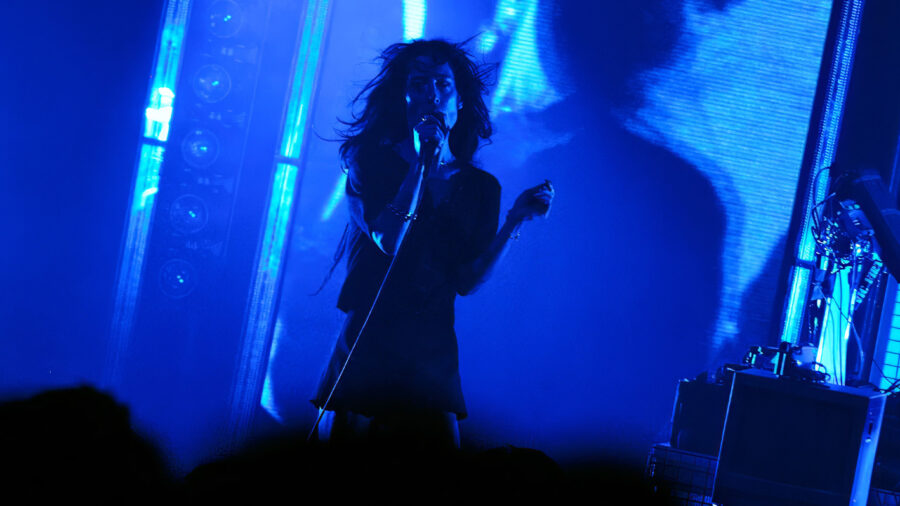
TM — I think we were a bit nervous about going into rooms this big. Do you lose a sense of intimacy? How do you build a show that’s big enough to fill these rooms, but also engaging enough to make them feel like there’s only 200 people in them?
And you know, so far, so good.
I think the credit goes to our production team and the vision we’ve had as artists as to how we want the show to look, feel and sound. It’s never felt as if the intimate moments have got lost, and it’s never felt like the big moments haven’t been big enough. Somehow, we’ve struck the balance.

G — The world can feel pretty heavy at times, and Jungle’s music offers a kind of escape. Has giving people that sense of release become more important to you?
TM — I think that’s a wonderful way to put it. Politicizing yourself as an artist is a double-edged sword and can go either way.
We’ve tried to hear people, hear pain, listen to it. We digest people’s troubles, we digest the troubles of the world. We’re very empathetic people, and being able to give people the space to experience pure joy is really important to us.
Every show before we go on stage, our mantra is let’s go and give people joy. People need to be able to release themselves from whatever pain they’re going through in their lives. That’s become a really important part of our mission.
G — Is there anything else you’d like to leave us with?
TM — If you’re able to connect with our music in whatever way possible, then thank you. If you can make it down to a show, we’d love to see you.
I think it’s really important for us to give people the opportunity to have real human experiences. Get off your phones, get into a room, enjoy that feeling of the ancient human tradition of communing with a group of people and experiencing the same thing at the same time.
Sunshine is out now via Caiola Records / AWAL.