Thundercat

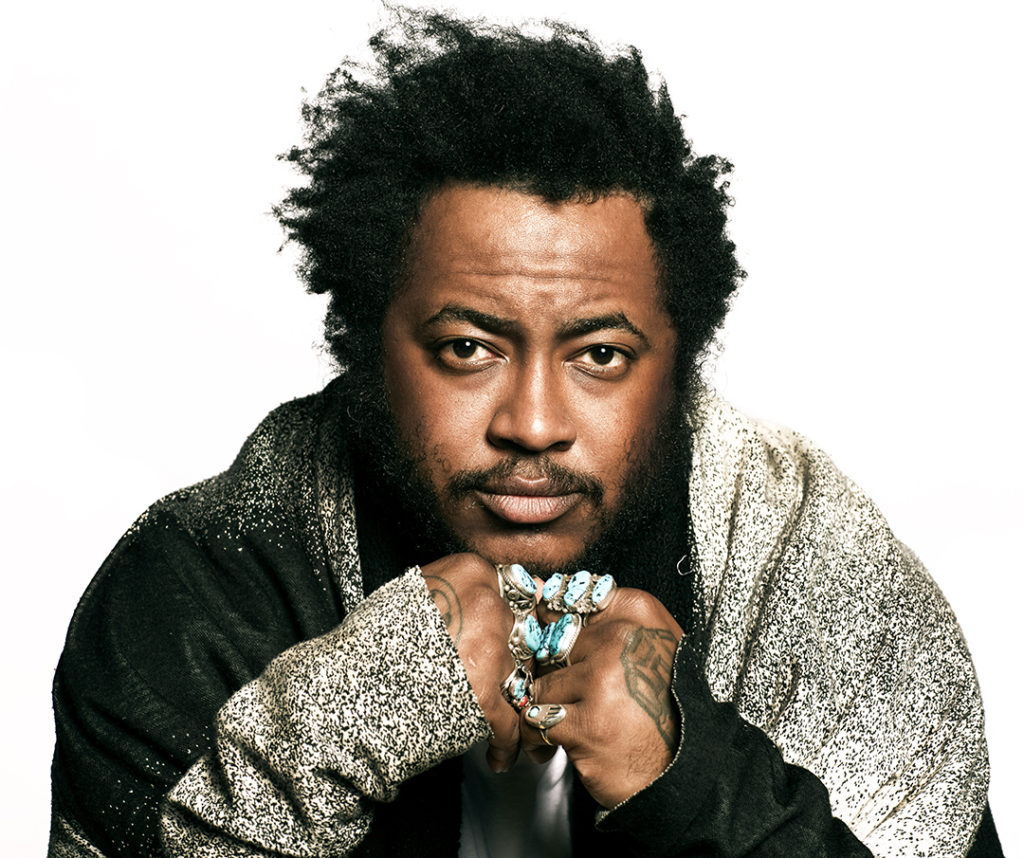
Thundercat is everywhere. If you have even a passing interest in boundary-pushing rap and R&B, you’ve probably found yourself floating through his orbit. Born Stephen Bruner, he is the son of Ronald Bruner, Sr., a drummer who played with Diana Ross and the Temptations. Bruner’s career has featured him writing, performing and recording with a diverse group of notable musicians including Herbie Hancock, Erykah Badu, George Clinton, and Suicidal Tendencies.

More than a hired gun, he’s developed his own sonic persona, starting with his collaborations with Flying Lotus and then coming into full view on his two blistering solo slabs of jazz fusion: 2011’s The Golden Age of Apocalypse and 2013’s Apocalypse. He returned this year with a surprisingly deep mini-album called The Beyond / Where the Giants Roam.
Bruner’s sonic DNA is intrinsic to the fabric of Kendrick Lamar’s iconoclastic statement To Pimp A Butterfly. His ebullient bass playing is prominently featured across the album, along with production credits on “Wesley’s Theory”, “Hood Politics” and “Complexion (A Zulu Love)”. His extensive involvement also put him in a position to see one of today’s greatest artists at the height of his powers from close-up.
“Kendrick is such a dynamic person, man. There’s more to what Kendrick does than [just] rapping,” says Bruner. “It translates in the words so heavily – it feels like an understatement to call him a rapper. Watching his process, watching how open he is to stuff, and when he’s open, he’s fully open. He executes everything that he thinks and it was an amazing process to see.”
Bruner’s influence on the album extends to letting Kendrick in on his encyclopedic knowledge of jazz as well as introducing Lamar to producer Taz Arnold of Sa-Ra, a former collaborator who presaged hip-hop’s current obsession with minimal funk. But his strangest impact on the album hinged on Kendrick Lamar’s preternatural sense of emotional perceptiveness.
“[While composing music for] ‘Mortal Man’, I had been going through a certain set of circumstances emotionally, you know? And I played it for Kendrick and with Kendrick not having seen me, as soon as he heard it, he said, ‘That sounds like something like this happened.” It was like on a whim that he got exactly where the music was coming from: from me. And it freaked me out.”
“He described whatever was going on with me to a T within five seconds and then walked out the room. It put a little bit of HD on everything, like high definition. It was like, ‘This guy’s on it!'”
With events like the Afropunk Festival and albums like To Pimp A Butterfly and D’Angelo and the Vanguard’s Black Messiah serving as contemporary mainstream responses to the unjust treatment of black people in America, there are striking parallels between the black music of today and that of the 1970s, another period of time where social upheaval made for timeless revolutionary music.
“Music has always been the soundtrack to life in a genuine way and art being an imitator of life, this is just the sights and sounds of what’s going on right now. Call it politically, economically, emotionally dealing with the same issues at different levels. This is the soundtrack to that.”
“I don’t wanna specifically call it black, even though it’s one of those things where it’s inevitable that it’ll be considered that to some degree but I feel like the reason that it resonates so hard is that everybody can feel it.”
“Whenever you talk to somebody that lived during the ’70s, they have this certain sense of peace about them. There was a bit of happiness amongst a bunch of darkness. These are those moments like that. Not knowing what’s gonna happen to our country, so to speak. Like, are we still dealing with racism? Is it still like a circus? Am I crazy or are they crazy? Maybe I’m crazy. This is the sound that comes with that.”
The Beyond / Where the Giants Roam finds Thundercat further exploring the vast landscape of his creative talents, a realm that has come to contain echoes of grunge, hard funk and R&B. The languid, relaxed tone of these songs belies the dark lyrics in a way that mirrors Bruner’s inward approach to dealing with problems in real life.
“Whenever stuff gets crazy, I really calm down. I’m the worst person to react to anything. I have catlike reflexes on accident but in real time, if somebody was gonna swing at me, I would get hit but hopefully it wouldn’t knock me out. That calmness comes from the genuine feeling of everything being completely out to lunch.”