Uzo Aduba
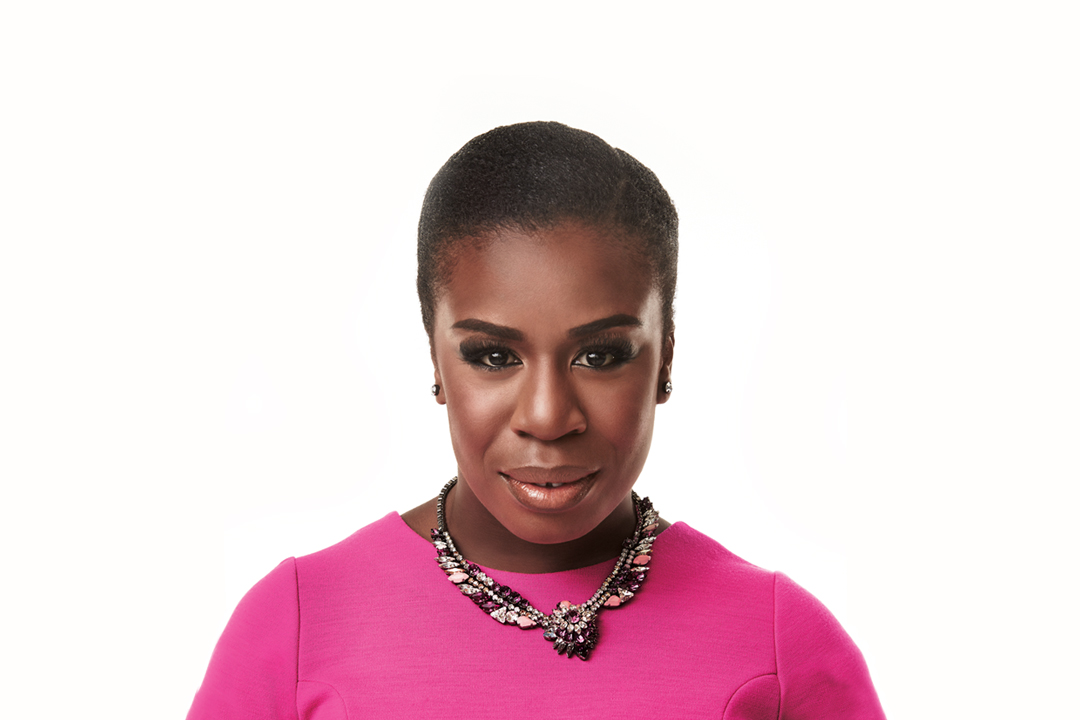
Arguably one of the biggest breakout stars of the hugely popular Netflix original series, Orange is the New Black, Emmy award-winning Uzo Aduba has become a favourite among fans and critics alike for her portrayal as Suzanne, a.k.a. “Crazy Eyes”. Georgie had the pleasure of speaking with Aduba about the lessons she’s learned from being on the show and the freedom that comes with playing Suzanne.
G—Season three of Orange is the New Black is starting soon, how are you feeling about that? Excited, nervous?
UA—I always get nervous — I’m that actor. And I can’t ever not be nervous. I get nervous no matter what, whether I have a play or a show to premiere. My cast mates will tell you that I’m definitely not the one you want to talk to before a release. [Laughs]
G—What makes you so nervous? Are you worried about how it will be received?
UA— All of it! I mean, I think it’s that and also it’s how my investment manifests itself. But yeah, I do get nervous. I want the work to be good—for everyone.
G—I’m sure it will be, judging by some of the previews I’ve seen. Speaking of which, in one of the previews for Season Three, Suzanne is shown having a meltdown over Vee. What does Vee represent to Suzanne?
UA—I think that Suzanne is an idol worshipper, as we saw in Season One, and you see a continuation of that through Season Two. [In Season Two] you get to see this balance of two stories playing out in her head, where Piper [Taylor Schilling] physically resembles her [adoptive] mother – but when we see the back-story episode for Suzanne, the Vee character more resembles the mother that she could have had. And she attaches herself. She has some mommy issues! [Laughs] And she’s so desperate. She wants to receive and give love, and I think she saw someone paying her attention who was seemingly open to giving her love, and she dove right in. With Suzanne, it doesn’t matter the cost when it comes to love—she will pay it to get it.
G—It’s interesting that you use the word “desperate”. When I think about what emotion characterizes Suzanne, desperation definitely comes to mind, but also frustration – she often seems frustrated with herself and with others. What other emotions do you feel come through in Suzanne?
UA—One emotion she is often confronted with is confusion. She doesn’t understand why someone wouldn’t want what she’s offering, which is love. I mean, I know I’ve been confronted with that in my life – that feeling of not understanding why someone wouldn’t want to be loved by someone who’s willing to give you all of their love. And that confusion can be misconstrued at times as crazy. I think that’s something that she wrestles with – wondering, why do people call me crazy? From her vantage point there’s a generosity in spirit being offered, and she doesn’t understand why that would ever be looked at as being crazy.
G—A big part of what makes her character so interesting is her physicality – the eyes, obviously, but also the way she moves and even the way she hits herself when she’s upset. Was that always the intention for her character, or was it something that you brought to the role?
UA—When I was making her in my mind I thought, she lives as someone who takes up a lot of space. I consider myself a very physical actor, either practicing stillness or practicing a lot of movement. And for Suzanne, it felt like she should have a lot of movement. There’s something frenetic inside of her that comes out in that way. I wanted her to occupy a lot of space because when I thought about her as childlike, I thought, that’s what a child does – they never sit still. Even if you’re in a nice restaurant, they’re going to be up and about doing their thing. So I wanted her to have the freedom to occupy a lot of space.
G— You didn’t initially audition for the role of Suzanne [Aduba auditioned for the part of Janae]. Do you feel it was a positive twist of fate that it ended up this way?
UA—I’m very happy to play her. I love her so much. I feel a responsibility to her now, having known her for three years. She has given me permission as an actor to really know that there’s never a wrong choice. When I realized that she is innocent like a child, I had to give myself permission to know there’s nothing “wrong” you can do as an actor – because children have no agenda. They’re not thinking about what they’re doing, they’re just doing it – and that’s how this woman operates. That was incredibly freeing in a new way. To be able to go in that direction and explore that fully was really exciting, and also challenging. You have the challenge of keeping it rooted in something – you can’t just drift off into la-la land. You have to keep it rooted in something, you know what I mean? Suzanne has taught me a lot about freedom and she’s also been so wonderful in the way of “just be you.”
G— The show succeeds in bringing a human element to people who are often thought of as villains. Has being on the show made you think differently about humanity? Has it made you less judgmental, for instance?
UA—Absolutely. The show takes the focus away from the crime. So often when you see the back-stories you rarely see what they did – that’s not the story. For a lot of the characters you don’t even know how they landed in prison. You realize it’s not about the number on their chest or the jumpsuit that they’re in. These are people – mothers, daughters, neighbours, granddaughters, employees, and employers – and it humanizes them in a different way. The greatest thing I’ve learned is that good people can make mistakes.
G—I think it’s taught many of the viewers that same lesson.
UA— Yeah. And Jenji [Kohan, the creator] was smart in choosing Piper Kerman’s story – the real-life Piper. There’s something about having this story be set in a minimum-security prison rather than a maximum-security prison. When you’re watching the stories – or reading, in our case – you realize you’re not so distant from these people. A lot of times it’s an infraction that got them imprisoned. It’s like slipping on a banana peel that landed you in this circumstance – we’re all one step away from that. So it kind of levels things out and, if nothing else, it makes you more empathetic – not always sympathetic, but empathetic.
G—I read that you really enjoy the process of rehearsing. Can you tell me a bit about that and why it’s so important to you?
UA—Oh, great question! I love rehearsal because I think that’s where you “find it.” The rehearsal room is almost like surgery. It’s where all the work gets done, and the performance is like seeing the treated person. And even though you love to see them in rehab, I like to get in there and make the incisions, dig around, find the problem and figure out how to handle this situation. “Do we need more anesthesia? I don’t know!” [Laughs] The rehearsal is where you get to go in there and make your mistakes, and you get to learn from your mistakes. It’s where you go to really dig in and figure out who this person is and what the story is that we’re telling. If there were still lands to discover on this planet I’d probably be an explorer. I like to figure things out and go on adventures in that way. I feel like that’s what happens in the rehearsal room, and once all the adventures are sought you put it out. That’s why I love rehearsal.
G—Before we finish, I’d like to touch on some of the charitable initiatives you support – it seems like that’s important to you. What are you involved with at the moment?
UA—I work with an organization called Opening Act, which is a group that brings arts education to underprivileged communities and underserved communities here in New York City. I love it and the kids are just amazing. They really are –they’re incredible. I also used to work with Broadway in South Africa and I would go to South Africa a lot. It’s kind of the same idea as Opening Act, but it’s for post-Apartheid children – the first generation of kids who are not born under apartheid. It’s about bringing social change through the arts, leadership skills through the arts, emotional coping mechanisms, writing, acting, music, dance, and directing to children living in Durban Johannesburg and Cape Town. I believe that we were all given a voice and I believe it’s our responsibility as members of the same human tribe to use that voice – and you don’t have to necessarily have the biggest microphone to do it. But I want to the best of my ability to try and make a difference in this world and give back in the best way I know how.